Sensor Failure Symptoms You Shouldn't Ignore
A check engine light that appears after a rough start is easy to dismiss when the vehicle still gets you to work. But sensor failure symptoms can begin that way: a small change in idle quality, fuel mileage, shifting, or throttle response before a more noticeable drivability problem follows. Your vehicle’s computer can only make good decisions when it receives accurate information.
Modern cars and trucks use sensors throughout the engine, transmission, exhaust, braking, and electrical systems. These components monitor temperature, airflow, wheel speed, oxygen content, crankshaft position, throttle input, and more. When one signal is missing, slow, intermittent, or incorrect, the vehicle may compensate for a while. That compensation can affect reliability, fuel use, emissions, and sometimes safety.
Common Sensor Failure Symptoms
A warning light is the most familiar sign, but it is not the only one. Some sensor faults set a diagnostic trouble code immediately. Others operate within a range that looks believable to the computer, even when the reading is inaccurate. That is why a vehicle can feel different before a dashboard light appears.
Engine-related sensor trouble often shows up as a rough idle, hard starting, hesitation during acceleration, stalling, reduced power, or poor fuel economy. You might notice a fuel smell from the exhaust, black smoke, or an engine that feels unusually weak when merging onto Highway 51 or climbing a grade. These symptoms can occur when the engine computer receives bad information about air, fuel, temperature, or engine position.
Transmission and speed sensor concerns may feel different. Delayed engagement, harsh shifts, inconsistent shift timing, a speedometer that drops out, or a transmission that stays in one gear can point to a sensor or related wiring problem. In some vehicles, the transmission control system will limit operation to protect internal components when it cannot trust a key input.
Brake and stability-control sensors deserve prompt attention. An ABS, traction-control, or stability-control light may come on when a wheel speed sensor signal is lost. Depending on the failure and vehicle design, normal braking may remain available, but anti-lock braking and traction assistance may not work as intended. That distinction matters in rain, on gravel, or during an emergency stop.
Symptoms Often Linked to Specific Sensors
Several sensors commonly cause recognizable patterns, but no symptom confirms a failed part by itself. A professional diagnosis should separate the sensor, its wiring, its connector, and the mechanical system being monitored.
Oxygen and Airflow Sensors
Oxygen sensors measure exhaust oxygen so the engine computer can adjust the air-fuel mixture. A failing sensor can contribute to reduced fuel economy, a check engine light, rough running, and emissions-test failure. Because exhaust leaks, fuel-delivery problems, ignition misfires, and vacuum leaks can produce similar readings, replacing an oxygen sensor without testing can waste money.
A mass airflow sensor measures the air entering the engine. Trouble here may cause hesitation, unstable idle, stalling, or a lack of power. Dirt, an air leak after the sensor, a restricted air filter, or damaged intake ducting can create the same complaint. Cleaning or replacing a sensor might help in the right situation, but it is not a substitute for finding the underlying cause.
Crankshaft and Camshaft Position Sensors
The engine computer uses crankshaft and camshaft position sensors to coordinate spark timing and fuel injection. Failures can cause extended cranking, intermittent no-start conditions, stalling after the engine warms up, misfires, or sudden loss of power. In some cases, the engine may restart after cooling down, which makes the issue especially frustrating and easy to misdiagnose.
These faults should not be handled with guesswork. A scan tool may show a related code, but checking live data, signal patterns, connector condition, and wiring integrity is often necessary. Timing-chain wear or mechanical timing issues can also create camshaft or crankshaft correlation codes.
Coolant Temperature and Throttle Position Sensors
A coolant temperature sensor helps the engine manage cold starts, fuel mixture, cooling-fan operation, and temperature reporting. An inaccurate reading can lead to hard cold starts, poor mileage, an overheating warning that does not match actual engine temperature, or cooling fans that run at unexpected times.
A throttle position sensor, or the sensors built into an electronic throttle body, reports accelerator and throttle movement. A problem may cause hesitation, reduced-power mode, surging, poor throttle response, or a warning light. Since electronic throttle systems are safety-related, a reduced-power message should be inspected rather than ignored.
Wheel Speed, Tire Pressure, and Parking Sensors
Wheel speed sensors are critical inputs for ABS, traction control, and stability control. A damaged sensor, corroded connector, broken wire, or damaged wheel bearing encoder can activate warning lights. The issue may appear only at certain speeds or after a turn if the wiring moves with suspension travel.
Tire-pressure monitoring sensors typically cause a tire-pressure warning light to flash or stay on. Check the actual tire pressures first, including the spare if your vehicle monitors it. If pressures are correct and the warning remains, a failed sensor battery, relearn issue, or receiver fault may be involved.
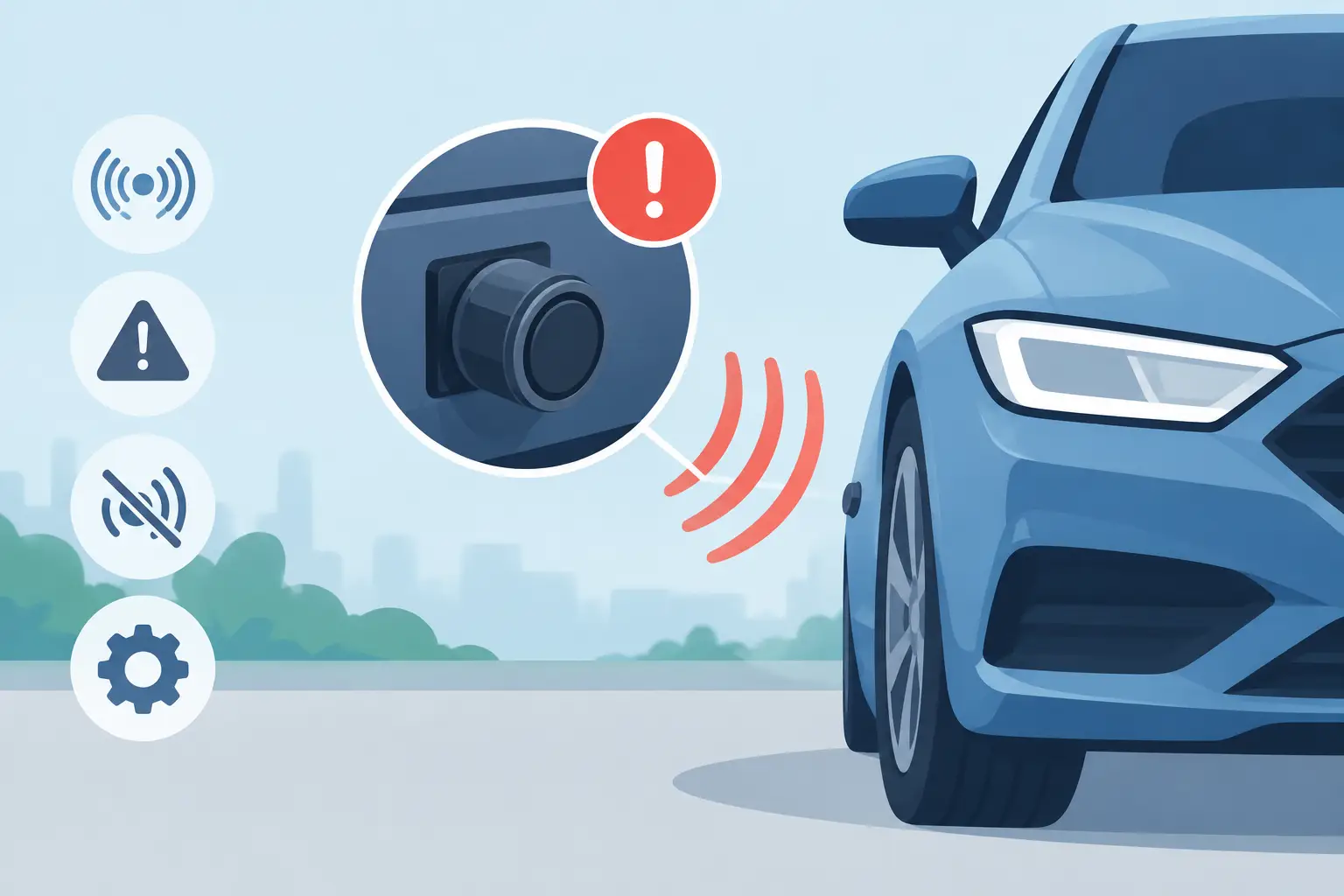
Parking sensors and backup-camera systems can also be affected by dirt, impact damage, moisture, or wiring faults. A single nonworking parking sensor may trigger a warning message or disable the system. Cleaning the sensor surface can be reasonable, but avoid scraping or pushing on it aggressively.
Why a Code Is Not a Repair Diagnosis
A diagnostic trouble code identifies a system that needs attention. It does not automatically identify the failed part. For example, a code related to an oxygen sensor may be caused by a wiring problem, exhaust leak, cylinder misfire, fuel mixture issue, or the sensor itself.
The same principle applies to many sensor failure symptoms. Low battery voltage, poor ground connections, corroded terminals, rodent-damaged wiring, and moisture intrusion can interrupt sensor signals. Replacing parts based only on a code or an internet search can turn a straightforward repair into a costly parts-changing exercise.
Accurate testing combines scan-tool data with a hands-on inspection. A technician can compare live sensor readings to expected operating conditions, test circuit voltage and ground, inspect connectors, and verify whether the mechanical system is behaving normally. This process takes more care than simply reading a code, but it provides a clearer reason for the recommended repair.
When You Should Stop Driving
Not every warning light requires a tow, but certain symptoms call for immediate caution. Stop driving and arrange service if the check engine light is flashing, the engine is overheating, the vehicle stalls in traffic, you smell raw fuel, or braking performance changes. A flashing check engine light commonly indicates an active misfire that can damage the catalytic converter.
If an ABS or traction-control light is on but the brake pedal feels normal, you may be able to drive carefully to a repair appointment. Leave extra following distance and understand that those electronic systems may not be available. If the brake warning light is on, the pedal is soft, or stopping distance has increased, do not treat it as a sensor concern until the braking system has been inspected.
Intermittent sensor faults also deserve attention, even when the vehicle is currently running well. A rough start once a week, a random stall, or a warning light that comes and goes can leave useful diagnostic information stored in the computer. Waiting until the vehicle will not start may make daily life harder and diagnosis less convenient.
What to Bring to a Diagnostic Appointment
Clear details help narrow the inspection. Note when the concern occurs: cold start, hot restart, highway speed, braking, rain, after refueling, or while the air conditioning is on. If a warning light appeared, avoid clearing codes before the appointment unless necessary. The stored code, freeze-frame data, and readiness information can help identify the conditions present when the fault occurred.
Share any recent repairs, battery replacement, collision damage, rodent activity, or water exposure as well. A sensor issue that begins after unrelated work may be connected to a disturbed connector, damaged harness, or missed installation detail. At The Auto Guy LLC, the goal is to identify the reason for the fault, explain the findings in plain language, and recommend only the repair the vehicle needs.
Your vehicle does not need to be undriveable before it earns a careful inspection. When a warning light, shifting change, rough idle, or inconsistent starting pattern appears, schedule diagnostics while the symptoms can still guide the repair.
Comments